

In the early days of Amazon, growth was simple: launch a product, turn on a few automatic ads, and watch the sales roll in. Those days are gone. In 2025, Amazon is a mature, hyper-competitive battlefield. Strategies that worked five years ago now lead to stagnating sales and eroding margins.
Many sellers hit a “glass ceiling.” They reach a certain revenue level, perhaps $500k or $1M annually, and then stop growing. Their ad costs rise, their organic rank slips, and they find themselves running faster just to stay in the same place.
This is where professional Amazon marketing agencies distinguish themselves from freelancers or software tools. While a freelancer might optimize a bid, an agency builds an ecosystem. They do not just chase today’s sale; they engineer the business for long-term Amazon brand growth.
This guide explores the specific, high-level amazon marketing growth strategies agencies use to break through revenue plateaus and build sustainable, asset-grade brands.

The most significant strategic shift agencies introduce is moving the focus from ACOS (Advertising Cost of Sale) to CLV (Customer Lifetime Value).
Solo sellers often obsess over efficiency. They pause any keyword that has a high ACOS. While this protects short-term profit, it often strangles growth. If you only bid on cheap, profitable keywords, you eventually run out of new customers.
Agencies view a customer as an asset. Using advanced data, they might calculate that your average customer buys your coffee pods four times a year.
By shifting the KPI to Customer Lifetime Value, agencies can bid more aggressively than competitors, stealing market share and fueling long-term dominance.
A common mistake is relying 90% on “Sponsored Products” ads. These capture people already looking to buy, but they do nothing to build a brand. Agencies implement a Full-Funnel strategy to capture customers at every stage of their journey.
Agencies use Amazon DSP (Demand-Side Platform) and Sponsored Brands Video to target shoppers who haven’t searched for your product yet. They target lifestyle audiences (e.g., “Camping Enthusiasts”) to plant the seed of your brand before the customer even knows they need a tent.
Here, the goal is to win the comparison battle. Agencies use Sponsored Display product targeting to place your ads directly on your competitors’ listings. If a rival has a higher price or a lower star rating, an agency will aggressively target that specific ASIN to poach the sale.
Long-term growth relies on repeat purchases. Agencies use Subscribe & Save campaigns and retargeting ads to ensure that once a customer buys, they never leave. They build a “moat” around your brand, making it difficult for competitors to steal your existing customers.
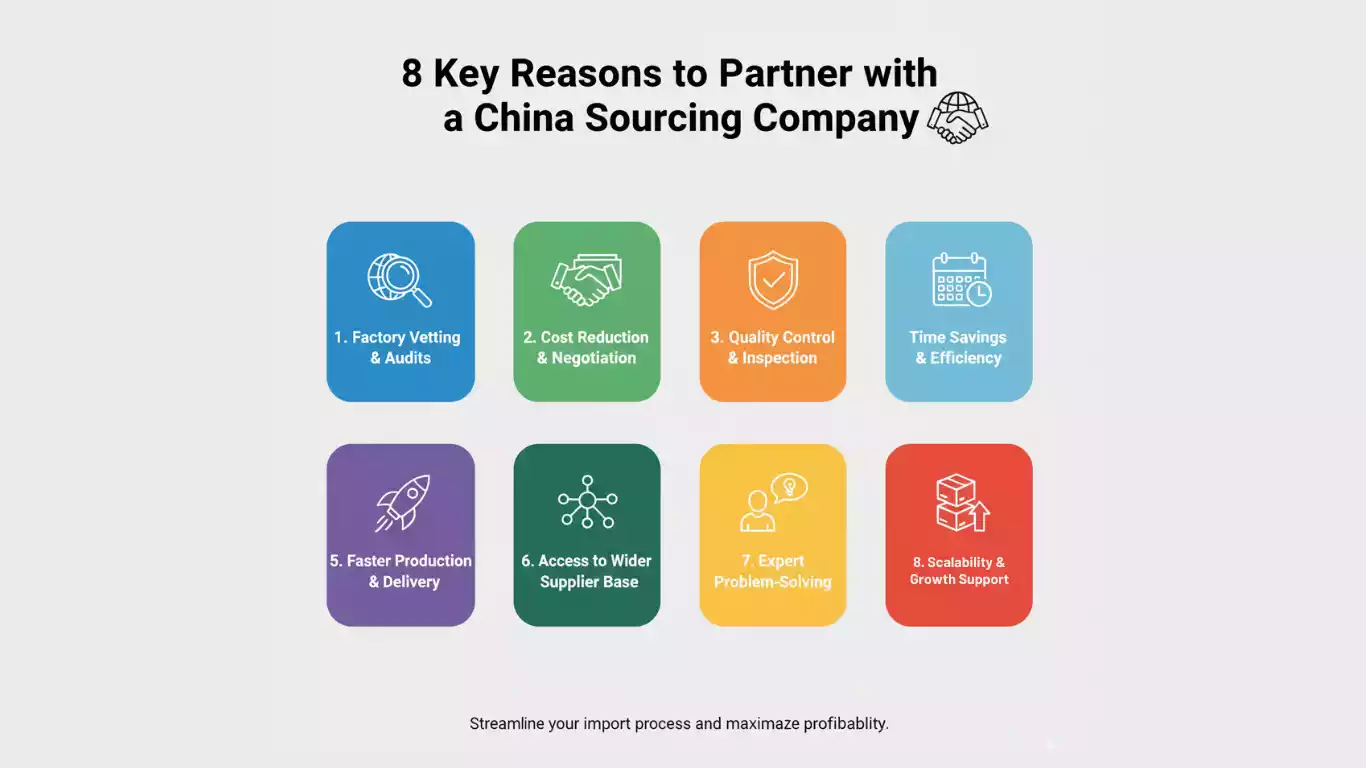
China is known for competitive pricing, but without local knowledge, you may end up paying more than necessary. Many factories charge foreign buyers higher rates, knowing they lack experience in price benchmarking.
A sourcing company solves this problem by negotiating on your behalf. They speak the local language, understand market rates, and know the cultural approach to negotiations.
Since they often manage bulk orders for multiple clients, they use their buying power to secure better deals. This means you not only save money but also get fair payment and delivery terms.
How sourcing companies help reduce costs:
Instead of focusing only on the cheapest option, sourcing agents ensure long-term value by balancing price, quality, and reliability.
One of the premier amazon ad agency benefits is access to and expertise in Amazon Marketing Cloud (AMC). This is a “clean room” database that allows for analysis far deeper than standard Seller Central reports.
Standard reporting uses last-touch attribution. If a customer sees your video ad, clicks a banner, and then days later clicks a Sponsored Product ad to buy, the Sponsored Product gets 100% of the credit. The video ad looks like a waste of money.
Agencies use AMC to see the entire path to purchase. They often find that while video ads have a high ACOS, they are the primary driver of new customers entering the funnel. Without AMC data, a seller might cut the video budget and accidentally kill their new customer pipeline. Agencies use this data to allocate budget scientifically, not just based on what looks good on a basic dashboard.
In 2025, Amazon rewards brands that bring traffic from outside the platform. This is a core component of modern amazon marketing growth strategies.
Agencies do not operate in a silo. They coordinate Amazon PPC with Meta Ads, Google Ads, and TikTok influencer campaigns.
The Strategy
Drive external traffic directly to the Amazon listing using “Amazon Attribution” tags.
The Reward
Amazon gives these sales a Brand Referral Bonus (a discount on referral fees) and, more importantly, a massive boost in organic ranking.
By treating Amazon as the destination for all marketing efforts, agencies create a halo effect. The external traffic boosts sales velocity, which improves organic rank, which lowers the cost of Amazon PPC. It is a self-reinforcing growth loop that is difficult for competitors to replicate.
You can have the best ad strategy in the world, but if your listing looks amateur, you will fail. Agencies understand that Conversion Rate (CVR) is the single most important metric for profitability.
Agencies employ graphic designers and copywriters to build “A+ Content” (formerly EBC) that tells a story. They use comparison charts to cross-sell other products in your catalog and high-quality lifestyle imagery to build an emotional connection.
With the rise of TikTok, Amazon has become a video-first platform. Agencies produce high-quality video assets for “Sponsored Brands Video” and product listing videos. They know that a shopper is 3x more likely to convert after watching a video than looking at a static image. Agencies constantly A/B test these creatives to find the winning formula.
This is the unsexy side of growth, but it is often what kills high-potential brands. Long-term growth is impossible if you run out of stock or get suspended.
Running out of stock doesn’t just mean lost sales; it means lost ranking. When you go out of stock, your organic rank plummets, and it can cost thousands of dollars in ads to regain it. Agencies use sophisticated forecasting tools to predict sales spikes (like Prime Day) months in advance, ensuring you stay in stock and maintain your position.
Amazon’s rules change constantly. A single policy violation can shut down a listing. Agencies have compliance departments that monitor account health daily. They know how to navigate complex issues like pesticide claims, hazmat reviews, and category ungating. This “insurance policy” aspect is a critical driver of long-term Amazon brand growth.
Launching new products is essential for scaling, but a failed launch is expensive. Agencies have a standardized “Launch Playbook” to maximize Amazon’s “Honeymoon Period, the first 30 days where the algorithm is testing your new product.
By executing a flawless launch, agencies can get a new product to page 1 in weeks, adding a new revenue stream to the brand portfolio.
Hiring an agency is a significant step. It moves a seller from solopreneur to brand owner. The strategies outlined above, AMC analysis, full-funnel targeting, and external traffic integration are complex and time-consuming.
Amazon marketing agencies drive long-term growth not by doing the same things you do, but by operating at a strategic level that is difficult to achieve alone. They turn your Amazon account from a cash-flow generator into a valuable, sellable asset.
For brands looking to scale beyond the plateau, the question is not “can I afford an agency?” but rather “can I afford to compete without one?”
While you may see efficiency improvements (lower ACOS) in the first 30 days, true strategic growth, like ranking improvements and brand building, typically takes 3-6 months of consistent execution.
A profit strategy focuses on lowering costs (cutting waste), often at the expense of volume. A growth strategy focuses on increasing market share (spending more), often accepting lower short-term margins for long-term dominance.
For brands doing over $1M/year, yes. DSP is the primary tool for retargeting and reaching customers off-Amazon. Without it, you are leaving a massive segment of your potential audience untouched.
Most growth-focused agencies charge a flat monthly retainer plus a percentage of ad spend or total revenue. This aligns their incentives with your growth; they only make more money if you grow.
No. Marketing acts as an amplifier. If you market a product with a 3.5-star rating, you will just accelerate the negative feedback. You must fix the product quality issues before investing in agency-level growth strategies.