

The landscape of Amazon advertising has shifted dramatically. A few years ago, success meant finding a few good keywords and setting a decent bid. Today, that approach is obsolete. The most successful brands in 2026 are using data-driven, full-funnel strategies that go far beyond basic “Sponsored Products” campaigns.
Top agencies now rely on sophisticated tools like Amazon Marketing Cloud (AMC) and Demand-Side Platform (DSP) to gain an edge. They are not just bidding on keywords; they are targeting specific customer behaviors and leveraging artificial intelligence to make decisions in real-time. For sellers who want to compete, understanding these advanced Amazon PPC strategies is no longer optional; it is survival.
This guide explores the exact tactics agencies are using right now to dominate niches, lower acquisition costs, and scale brands effectively in 2026.

The biggest leap in Amazon ads optimization for 2026 is the widespread adoption of Amazon Marketing Cloud (AMC). In the past, sellers relied on basic reports that only showed the “last click.” If a customer saw a banner ad, then a video ad, and finally clicked a Sponsored Product ad to buy, the Sponsored Product got 100% of the credit. This led to bad budget decisions.
AMC changes this by allowing agencies to see the entire customer journey. It is a secure “clean room” where Amazon’s data is merged with your own brand data. Agencies use this to understand which combination of ads actually drives a purchase. They can see if running a video ad before a search ad leads to a higher conversion rate, allowing them to allocate budget more intelligently.
The real power of AMC lies in audience creation. Agencies build custom segments that are impossible to target through standard Seller Central. For example, they can create an audience of shoppers who added to cart in the last 30 days but did not purchase, and exclude those who bought a competitor’s product.
This level of granularity allows for hyper-targeted campaigns. Instead of wasting money on broad audiences, you serve ads only to the people most likely to convert. This is one of the most critical Amazon PPC tips 2026 for maximizing return on ad spend (ROAS).
While Sponsored Products capture demand, Amazon DSP (Demand-Side Platform) creates it. Agencies in 2026 are heavily investing in DSP to reach customers both on and off Amazon. Unlike standard PPC, which targets keywords, DSP targets people based on their behavior.
DSP allows you to show display and video ads to shoppers who viewed your product but didn’t buy, retargeting them on websites like CNN, IMDb, or Twitch. This keeps your brand top-of-mind. Agencies use “sequential messaging” here. They might show a lifestyle video to a new customer, followed by a product benefit image to someone who clicked, and finally, a discount code to someone who abandoned their cart.
The days of manually adjusting bids once a week are over. Advanced agencies now use AI-driven software to adjust bids thousands of times a day. These algorithms analyze historical data to predict exactly when a conversion is most likely to happen.
One specific tactic is Dayparting. Data often shows that conversion rates drop significantly between 1 AM and 5 AM, or that costs spike during specific rush hours. Agencies use AI to automatically lower bids during low-performance windows and increase them during peak buying times. This ensures that every dollar is spent when it has the highest probability of generating a sale.
Furthermore, advanced Amazon PPC strategies now involve “rules-based automation” layered with AI. For example, an agency might set a rule: “If a keyword has 10 clicks and 0 sales, automatically lower the bid by 20%.” The AI executes this 24/7, protecting the budget from wasted spend far faster than a human manager could.
Static images are losing their effectiveness. In 2026, video is the dominant format. Agencies are pivoting heavily to Sponsored Brands Video (SBV) and Sponsored TV. These formats not only have higher click-through rates (CTR) but also allow for better storytelling.
The strategy here is to occupy more “real estate” on the search results page. A video ad takes up significantly more screen space on mobile devices than a standard text ad. By using video, agencies push competitors further down the page, effectively blocking them from visibility.
Effective video strategies for 2026 involve creating short, 15-second clips that work without sound. These videos focus immediately on the product’s problem-solving benefit. Agencies also run separate video campaigns for specific keywords, rather than one generic video for the whole account, ensuring the message matches the user’s search intent perfectly.
A common mistake is trying to make every campaign do everything. Top agencies separate campaigns by their specific objective. They run distinct Ranking campaigns and Profitability campaigns.
The goal of a ranking campaign is not immediate profit; it is sales velocity. Agencies select 3-5 super-relevant keywords and bid aggressively on them using Top of Search multipliers. They are willing to break even or take a slight loss on these ads because the goal is to tell Amazon’s algorithm, This product is popular for this keyword. This drives organic ranking, which eventually brings in free traffic.
Once a product is ranked, the focus shifts to profitability. These campaigns target “long-tail” keywords (phrases with 3+ words) that have lower search volume but higher conversion rates. The bids are lower, ensuring a high ROAS. By separating these goals, agencies prevent high-cost ranking efforts from draining the budget of profitable, established products.
In 2026, Amazon ads optimization extends off the platform. Amazon loves external traffic. Agencies are now coordinating Amazon PPC with ads on TikTok, Instagram, and Google.
They use Amazon Attribution tags to track this external traffic. The strategy is to drive traffic from a TikTok influencer or a Google Ad directly to the Amazon listing. Amazon rewards this external traffic with a referral bonus (lower fees) and, more importantly, a boost in organic ranking.
This creates a halo effect. The external traffic drives sales, which improves the product’s sales history. This improved history makes the internal Amazon PPC ads perform better, lowering the overall Cost Per Click (CPC). It is a holistic ecosystem approach that isolates specific channels less and integrates them more.
The era of set it and forget it Amazon advertising is over. The advanced Amazon PPC strategies for 2026 require a sophisticated mix of data analysis, automation, and creative storytelling.
Agencies are winning by using Amazon Marketing Cloud to see the truth behind the data, DSP to target shoppers across the web, and AI to optimize bids in real-time. They separate ranking goals from profit goals and treat video as a primary format, not an afterthought.
For sellers, the path forward is clear: move beyond basic keywords. Adopting even a few of these advanced tactics, like dayparting or basic video ads, can provide a significant competitive advantage. As the platform becomes more complex, those who master these tools will be the ones who dominate their categories.
Communication barriers are one of the biggest causes of sourcing problems. Many suppliers don’t speak fluent English, and cultural differences can make negotiations tricky. Miscommunication often leads to delays or incorrect orders.
A China sourcing company bridges this gap. They are bilingual, understand local culture, and know Western business expectations. This ensures that your requirements are clearly communicated and respected.
How sourcing companies improve communication:
This balance of language skills and cultural awareness makes supplier relationships smoother and more professional.
When your business grows, managing sourcing becomes more complex. Larger orders, multiple suppliers, and new product lines can quickly overwhelm a small team. A sourcing company provides the support you need to scale without losing control.
They coordinate between factories, monitor production timelines, and secure bulk discounts as your order volumes increase. Whether you’re entering new markets or expanding your product range, they help you grow steadily.
Here’s a quick comparison of how sourcing companies support growth:
| Growth Challenge | How Sourcing Company Helps |
| Larger order volumes | Manages multiple factories efficiently |
| New product launches | Finds reliable manufacturers quickly |
| Market expansion | Speeds up sourcing timelines |
| Maintaining quality | Ensures inspections at every stage |
This infrastructure lets you expand confidently, knowing your supply chain can keep up with demand.
Running a business requires focus. If you spend too much time managing suppliers, solving shipping delays, or checking quality, you’ll have less energy for marketing and sales. A China sourcing company takes over these tasks so you can focus on growth.
By outsourcing supplier management, you free up time to work on brand building, customer engagement, and revenue generation. This division of labor makes your business more efficient and scalable.
Key tasks sourcing companies handle:
This allows small businesses to operate like larger companies, giving them a competitive edge.
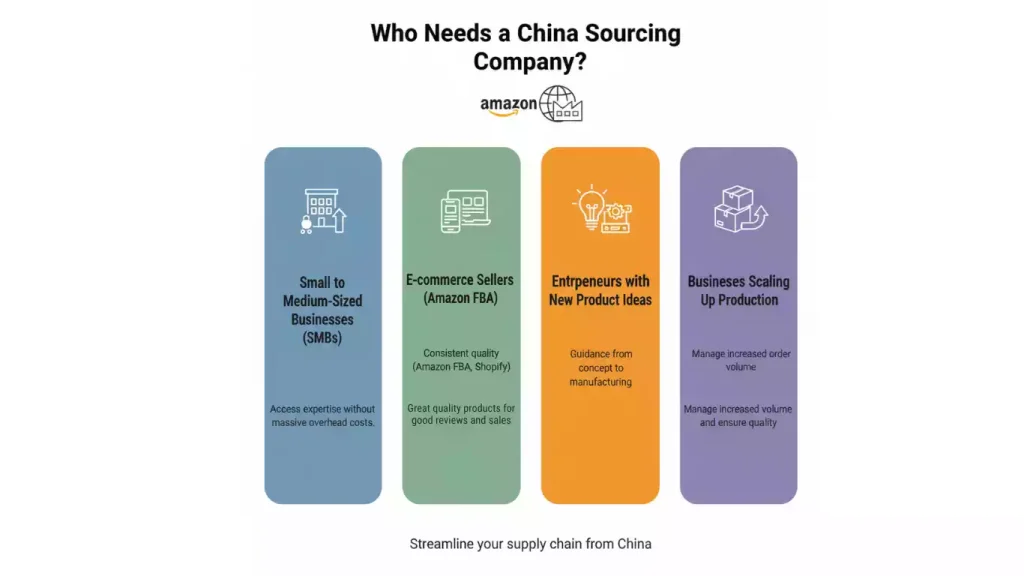
So, is hiring a China sourcing company right for you? Here’s a look at who benefits the most:
If you’re a smaller business, you often don’t have the resources to fly to China, hire local staff, or manage everything yourself. A sourcing company gives you access to that expertise without the massive cost.
Many online sellers rely on products from China. A sourcing company helps them get quality products consistently, which is key for good reviews and sales. They handle the factory side, so you can focus on your online store.
If you have a unique product idea but no experience in manufacturing, a sourcing company can guide you through the whole process, turning your idea into a real product.
As your business grows, your orders get bigger and more complex. A sourcing company helps manage this increased volume efficiently, ensuring consistent quality and timely deliveries.
Not all sourcing companies are the same. When you’re looking for the right partner, consider these points:
How long have they been in business? Do they have good reviews or testimonials? Ask for references if you can. Experience means they’ve learned lessons and built strong relationships.
Can they communicate clearly with you in your language? Do they respond quickly? Good communication is key to avoiding problems.
How do they charge? Is it a flat fee per order, a percentage of the product cost, or something else? Make sure it’s clear and you understand all the costs involved.
What are the steps they follow from finding a factory to shipping? A clear, detailed process shows they are organized and professional.
While many companies are general, some might have more experience with certain types of products (e.g., electronics, textiles). This can be a big plus.
Hiring a China sourcing company is no longer just an option; it’s becoming a necessity for businesses that want to source safely and scale efficiently. From supplier verification and negotiation to quality checks and logistics, sourcing companies handle the toughest parts of importing so you can focus on growth.
Whether you are a startup looking to avoid costly mistakes or an established business aiming to expand, partnering with a reliable sourcing company ensures smoother operations, reduced risks, and long-term success in the global market.
Sponsored Display is a self-service ad type available in Seller Central that is easier to set up but has limited targeting. Amazon DSP is a premium platform that offers far more advanced audience targeting, access to non-Amazon websites, and video inventory, usually requiring an agency or a high minimum spend.
AMC is technically free to use, but you need to be eligible (typically having a DSP account) and often need a third-party software or agency to help you write the SQL queries and visualize the complex data it provides.
While you can start basic PPC with $50/day, advanced strategies like DSP often require budgets of $5,000 to $10,000+ per month to be effective due to the high volume of data needed for the algorithms to learn.
AI is excellent for bid adjustments and data crunching, but it cannot replace the strategic thinking of a human. A manager is still needed to set the overall strategy, create the ad visuals, and interpret the “why” behind the data.
The most critical trend is the shift to “full-funnel” advertising. You can no longer just target people ready to buy; you must use video and display ads to build awareness and retargeting to capture sales that would otherwise be lost.